
Powers of Ten
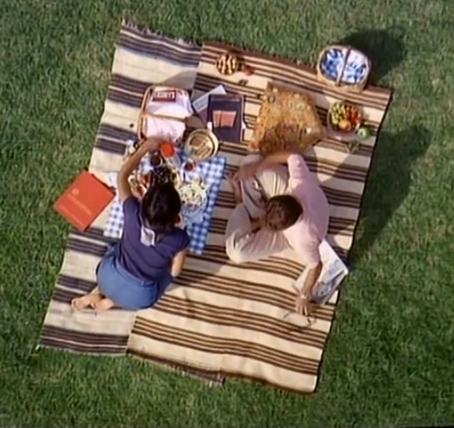
This type of shot is known as the ‘powers on ten’, which emanates from two documentary films written and directed by Charles and Ray Eames for IBM, depicting the relative scale of the Universe according to an order of magnitude (or logarithmic scale) and based on factors of ten.
The image (below) shows the beginning of the shot. It is a ‘top down’ camera, fixed on a couple sat on a picnic blanket.
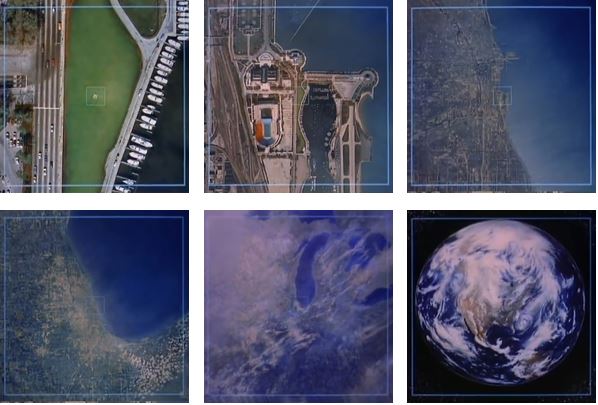
You can see in the image (below) that as the camera pulls out, unless we are using an absolutely huge painting, at some point the resolution of the map painting will degrade or we will run out of matte painting.
No computer is powerful to process an image of this size, let alone be able to animate into or out of it.
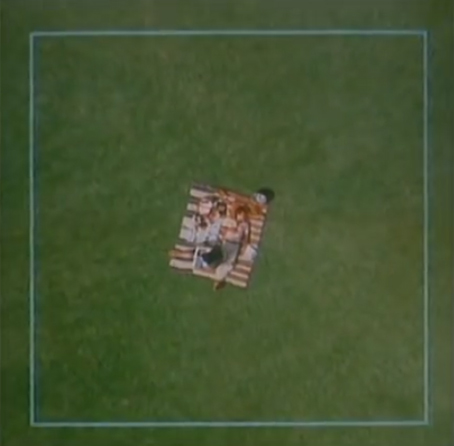
Instead we use a technique known as ‘nested projection’.
We can think of each of these squares as an individual 4k resolution matte painting (below), each being projected onto a surface. As the camera pulls out, it reveals a new projection at an acceptable resolution.
Layered Hierarchical Projection
This is a projection that resides inside of another projection along the shot camera path. To implement this, we create multiple projection cameras by duplicating our shot camera at various positions along its motion path.
We then remove the animation from each so they are all static – but all at different positions and angles based on the shot camera at various stages along its motion path.
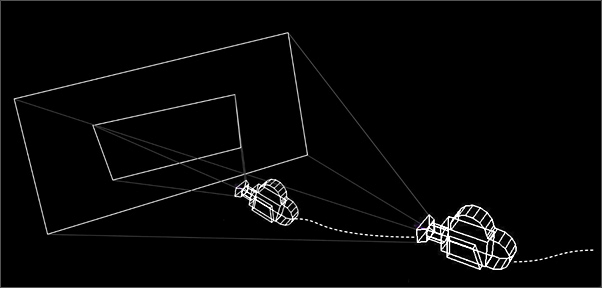
Each camera projects an increasingly small section of the image but at the same resolution and, because the camera, projecting the image onto the geometry is incremetally closer, resolution is maintained. By the time an image is blown our beyond its native resolution, it has already gone beyond the screen boundary the ‘closer’ image has replaced it in the centre of frame.
The image (below) shows the initial node setup inside NUKE. The scene depicts a street scene with renders taken from four points in the path of the moving shot camera as it moves forwards into the street. All the renders are the same resolution but incrementally depict a smaller surface area, but with increasing pixel detail.

To create the dynamic ‘picture in picture’ outcome, the images are incrementally nested over each other using a merging procedure. In NUKE this uses a shader node called MergeMaterial.

The image (below) shows the nested projection from the perspective of the shot camera. I have tinted the renders so it is possible to visualise the influence of each projection.
As the camera pushes forwards, the areas with more coverage (red) disappear out of the display area and are replaced with the next image in the set (green) which shows less coverage but at grreater detail. This is then in turn replaced by the next image (blue) which has the most confined view but the highest detail.

It is therefore impossible for any area of the matte painting to go out of focus.
However an issue of concern would be the transition points between the various projections as these cast at arbitrary angles that are determined by the position and angle of area projection camera. If I wanted to apply a global change to this scene such as a graffiti efect or light gradient that transected one or more projections, the adjustment would have to be applied to several different images and it would be challenging to ensure seamlessness when the images were reprojected.
The video (below) shows my experimentation with this technique.
 Peter Holmes PhD Journal